Brian
Mork
Intrepid Creativity (Increa) TM,SM
© 2004-2023 by Brian Mork
Home •
Wiki
• Blog 
Space
Ops & Design - I helped
bootstrap the
United
States Air Force Academy's Astronautics department small
satellite
and stratospheric balloon
program back in 1996. It was a heady, entrepreneurial
time that I
tremendously
enjoyed. Ron Humble was a critical part of those years, and I was
sad to hear of his death in 2002 (Instar obituary).
As of 2023, the program has grown into the Space Systems Research Center. I was involved with the following launches:
- Glacier - March 16, 1996 (balloon) - Late one evening on a hill
far Northwest of Falcon AFB, we were doing ground receiver tests.
Gil Moore (Smallsat Lifetime Award, Obituary) said, pointing to a step ladder, "Get up there and get it
working!" From that beginning, I helped with
communication operations and
launch/recovery activity. Seeing live video of a payload cut
loose
from 94,000 feet above a weather front crossing Colorado is
irreplaceable,
especially when your impressionable 9-year old child is with
you.
The payload tested magneto-torquing effects.
- Blue Moon - May 17, 1996 (balloon) - This mission was flown to
test active
thrust
stabilization
of a platform. I spec'd, designed, and helped build/debug the
telemetry
modulation and communications subsystems.
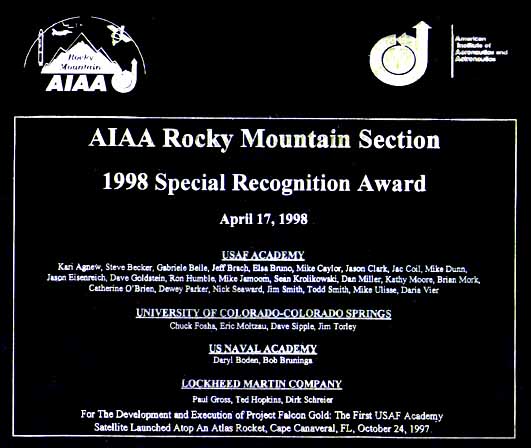
- Falcon
Gold - April 20, 1997 (balloon) and October 24, 1997
(satellite) - The
Falcon Gold project included designing and building a GPS-sampling payload
that hitched a ride on an Atlas booster in October 1997, after flying a
prototype on a balloon to 106,000 feet. Communication was done with a
modified Amateur Radio data modem.
As part of the balloon payload recovery
team with Amateur Radio background, I
had a special challenge DF'ing to the descending payload. We
were
led to a Pueblo, Colorado landfill, but then the signal behaved
erratically.
Turns out two locals saw the descending parachute, recovered the
payload
into their pickup and drove away with it! We ended up driving
up
and down civilian subdivisions as a caravan of civilian, government
&
military vehicles, with racks of equipment, a trailer of stuff
reminiscent
of the "Roswell incident", military people peering out of the windows,
and antennas everywhere -- looking everything like a scene out of
X-files.
We found the payload stashed in a storage shed behind a house occupied
by only a suspicious grandma. Turns out she personally knew
the Sheriff.
Interesting outcome...
- FalconSat, May 2, 1998 (balloon) - This effort studied
charging effects, with concurrent commitment to a bus
design versatile enough for future launches. My primary
emphasis
this time was supervising and teaching cadet teams who are building the
Command Telemetry and Data Handling hardware and software.
The first
satellite under this program launched in Nov 1999.
- FalconSat I (27 Jan 2000) - FalconSat X (planned launch Fall 2023). The Falcon program has grown. Visit the SSRC webpage to read about each mission.
In addition to hands-on engineering, I'm interested in larger policy
issues.
I'm the only Air Force pilot who was selected to attend Air Force Space
Command's Space Tactics School before it integrated with the US
Air Force Weapons School (wikipedia)
at Nellis AFB (which now has
separate tracks
for Pilots, Intel Officers, and Space Operators). I learned about
National
level activities in space, military ops, national launch ops, launch
vehicles,
ground site capabilities, and a ton of national and international
infrastructure.
I'll forever be an ambassador and pilgrim of space capability after my
time there. As part of the graduate-level curriculum, I wrote a paper
about
trends toward
intelligent, distributed constellations
rather than intelligent satellites. Commercial trends
of satellite constellations can be found on Lloyd Wood's satellite
page. I've also been privileged to participate in
the annual
Secretary of the Air Force's Science
Advisory Board studies about Unmanned Aerial Vehicles (1996)
and integration
of Air Force infrastructure into space (1998), and taught the Space
Test
course at the USAF Test Pilot School.
Through the years, I've applied for an astronaut position with NASA.
The
Air
Force Special
Flying Programs nominated me in 1993/5/7, but NASA did not
invite me
to interview. A Spring 1998 visit to the Astronaut and
Astronaut
Selection offices clued me in to better ways to present my
package, and
I applied again to the 1999 board as a civilian. I was called
for
an astronaut
interview during
February 2000, but
didn't make the final cut. I submitted applications for
subsequent
astronaut selection cycles with various levels of success
(2003/08/12/16). An application in 2020 will be my 9th
application. In the
meantime, I watch for
exciting
work in areas of aviation, remote sensing designs (in
particular
software, command & control, telemetry, and autonomous behavior).
The
background picture for this page is a picture of the space shuttle
after landing at Edwards Air Force Base. Starting in 2004, I
trained and qualified with DDMS
as on On-Scene Commander (OSC) for when the
shuttle diverts to Edwards AFB. Riding in a 1970s era modified
mobile home trailer, the OSC rides with the NASA commander and is
responsible for all DoD supporting organizations such as Fire &
Rescue, Security Police, Hazmat, Medical, Public Relations, etc.
We did many exercises and I had a chance to participate in
one real shuttle
landing.
This page is maintained by Brian Mork, owner &
operator of IncreaTM
// It was last modified Nov 2023. Suggestions for changes and
comments
are always welcome. The easiest way is to contact me via e-mail.