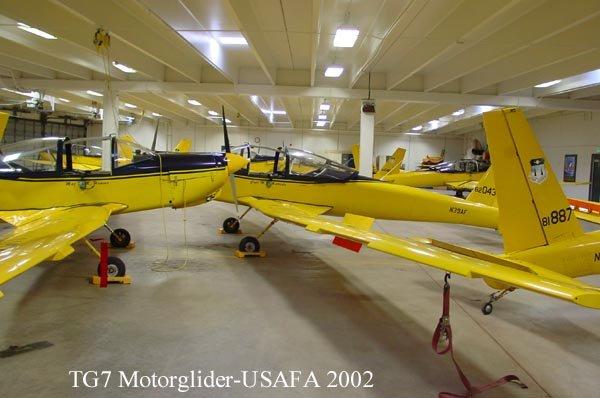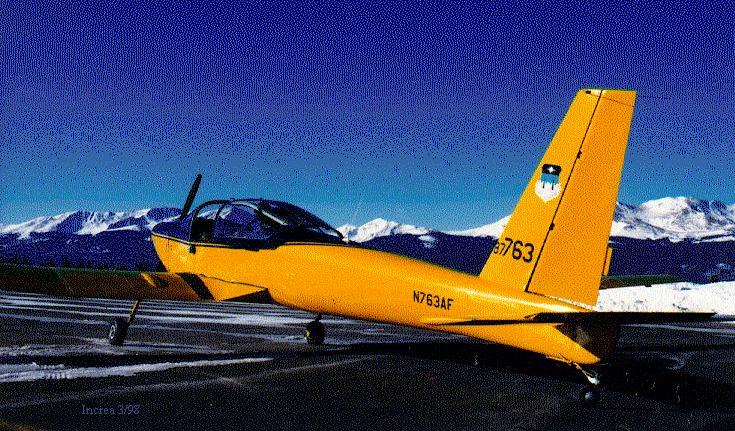
The TG-7A airplane is one of those airplanes you just won't see many places in the world. I believe it's original mission was only at the United States Air Force Academy and maybe on a few special CIA missions. It was made on special order from Schweizer to perform similar to a 2-33, ...but with an engine: fifty-nine and a half feet of wing, and a 112 HP Lycoming O-235 up front.
The combination has a few quirks. I don't know of any other plane where you recover from inverted, stall/spin situations by yanking back on the stick. Specifically, in these situations, the airplane Technical Order (flight manuals) reads, "..it is more expeditious to pull straight through to the horizon (Split S [or slice-back]) than to roll to a wings level upright attitude." Flight experience shows this to be true. Those long wings take a long time to roll wings level!
I had the chance to fly the TG-7 while stationed at the Air
Force Academy,
and while most of the flights were student instructional sorties,
I had a chance to investigate a few fun airports tucked into the
crevices
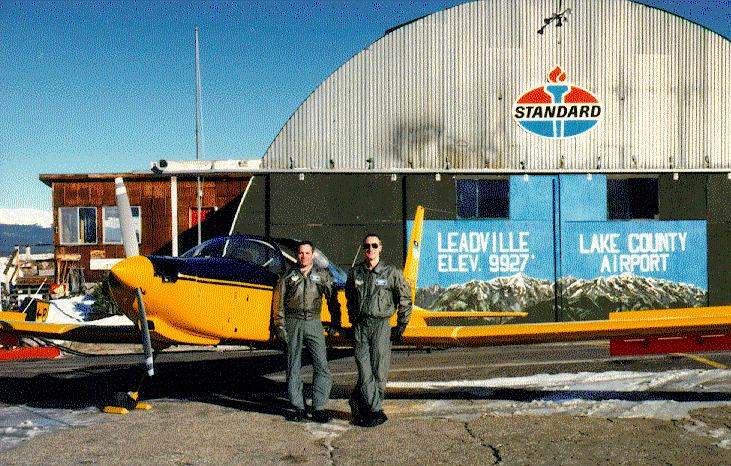
of the Rocky Mountains. The pictures below are from a drop-in at
Leadville, Colorado, the highest airport in the Continental United
States (CONUS). Downwind for landing at Leadville, Colorado is
flown over 10,000'
MSL. While stationed at the Academy, we flew with special waivers
to fly with oxygen up to 14,500 feet.
Click on the picture to get the fullsize image of the two pictures. Both were taken before the days of digital cameras; they're scanned in color photos.
The 94th
Flight Training Squadron maintains their own web page with
more mission
information. In December 2004, Soaring magazine published an article
I wrote about the TG-7 after they were excessed from the Air Force
inventory. I believe several went south to Texas, one north to
North Dakota, and found new homes outside of Detroit, Michigan. Only a handful remain registered with the FAA. They were tested for strange stall characteristics back in the 1980s.
My time with the TG-7 started what has
been a long association with gliders and soaring. In 2010 I
obtained my CFI-G rating, and do instructional flights
with my job at the USAF Test Pilot School. I also maintain
membership in two soaring clubs.
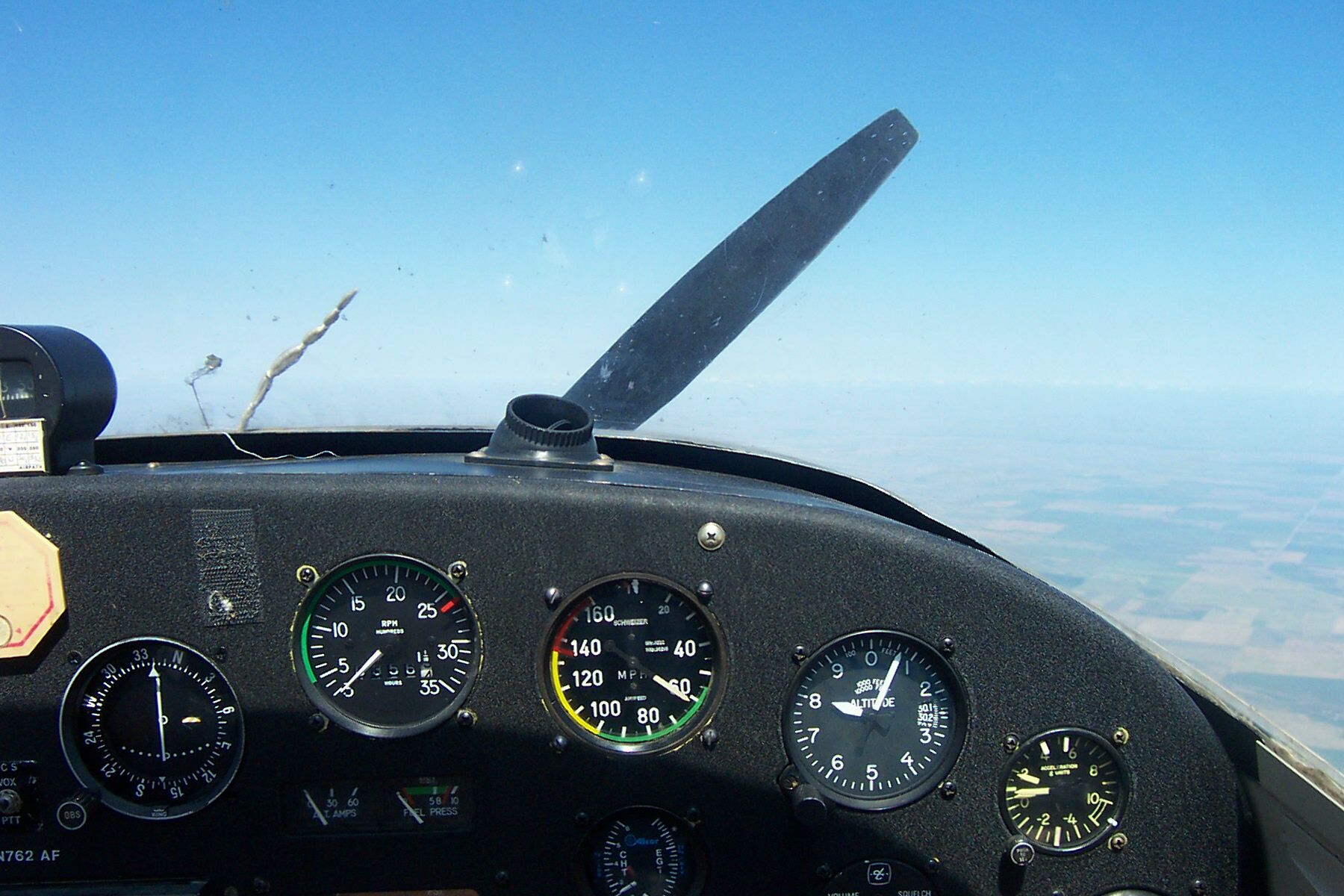 The
picture here shows a prop-stopped glide enroute to North Dakota from
Colorado. If you click on the picture, a
.mov video will attempt to play on your computer.
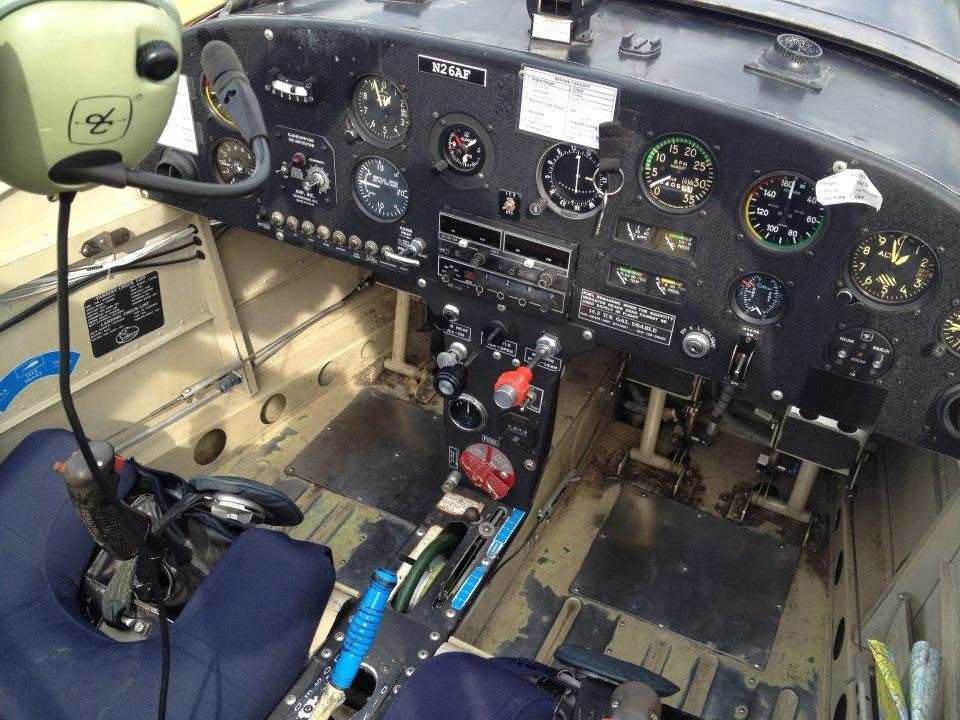
On the video, notice 3 instruments are visible across the instrument
panel - Engine RPM, Airspeed, and Altimeter. Video is how
much of the testing documentation was done back in the 1950s and 60s,
so enjoy this short 5 MB video snippet!
The
picture here shows a prop-stopped glide enroute to North Dakota from
Colorado. If you click on the picture, a
.mov video will attempt to play on your computer.
On the video, notice 3 instruments are visible across the instrument
panel - Engine RPM, Airspeed, and Altimeter. Video is how
much of the testing documentation was done back in the 1950s and 60s,
so enjoy this short 5 MB video snippet!
The video starts about 7800 MSL, 0 RPM and accelerating through 70 MPH at about 2 MPH / second. The propellor flips through a piston top-dead-center at about 90 MPH and then stalls against compression until about 108 MPH. Reaching 110 MPH, the prop turns over and catches with a fast rise in engine RPM. Altitude continues down to about 7000 MSL until the aircraft levels off with the engine running. Airspeed within 10 MPH of yellow arc limit is required to get the propeller turning.